2D Digital Art Tutorial: Freyja Corpse Ripper

Creator of 'Freyja Corpse Ripper', Alex Frasca, is a 22-year-old recreational character designer and illustrator from Long Island, New York. She is currently pursuing an undergraduate mathematics degree. Frasca entered Art War 2 to push herself to become a better artist, as well as, grow closer to the Cubebrush community! She is now a finalist in the 2D division and takes us through her creation here.
Concept
As with every serious concept I do, I begin with warm-up sketches that are unrelated to the main idea (anatomy, shapes, faces, etc.). I like to make sure I’m confident with my lines and able to produce shapes and movement that I’m happy with before I even consider pursuing my main idea. This approach can be time-consuming, but to me it’s worth it. Sometimes during the warm-up process I get inspired enough to jump right in after just a few minutes.
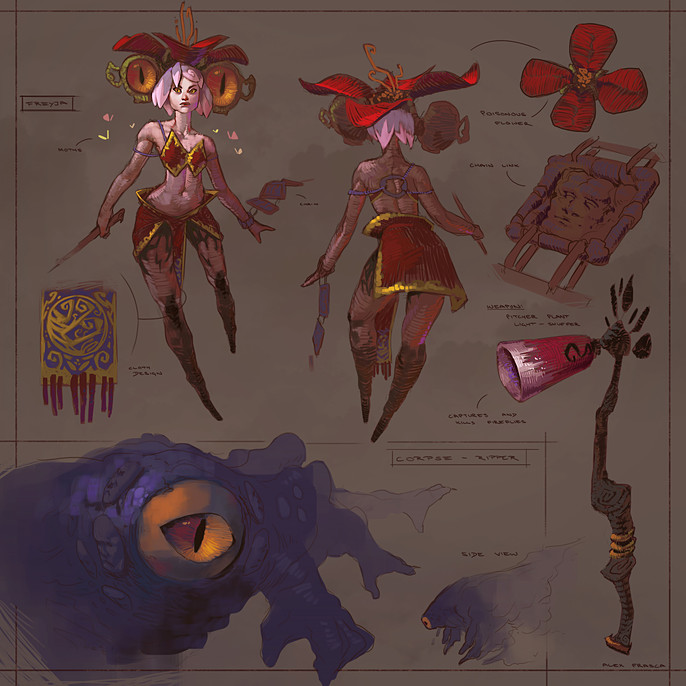
Here was the first sketch I came up with for Freyja Corpse-Ripper. Before beginning the concept, there were a few things I knew I wanted: a dark character, a female, and at least two unique design elements I had never used or seen before on any character (these would eventually be the demonic eye crown and the candle-snuffer weapon).
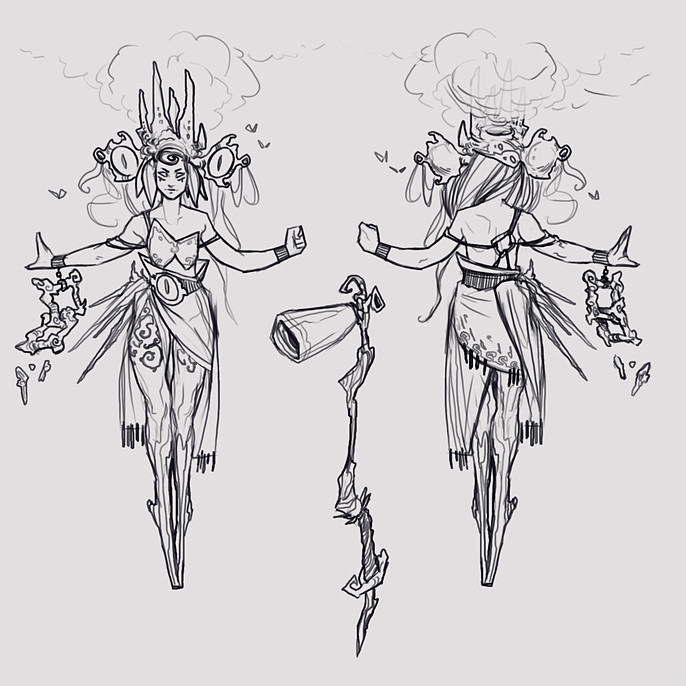
Once I started working on Freyja, I realized that one of her elements was going to be plant-related. Initially, I wanted her to have greenish spikes and a sort of stinking mushroom on her head. I also decided that she would have a demonic crown with semi-feline eyes that would later translate into a larger design aspect of this piece.
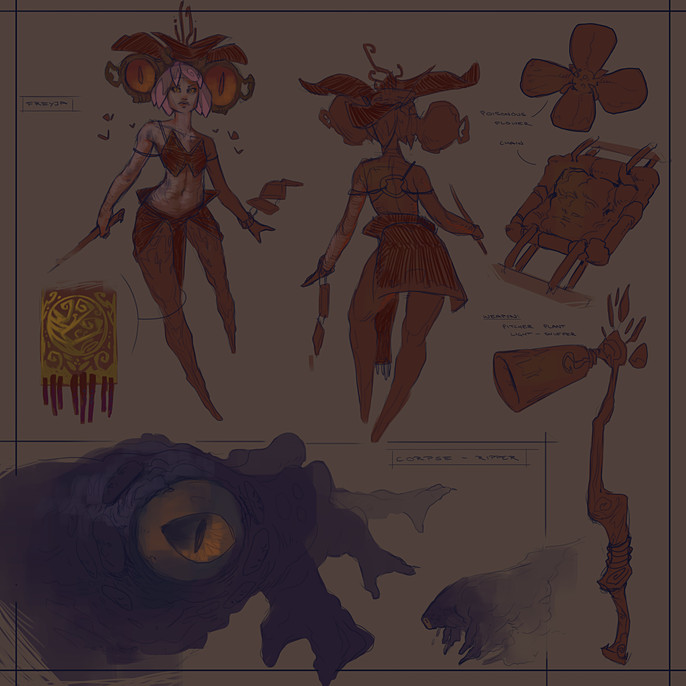
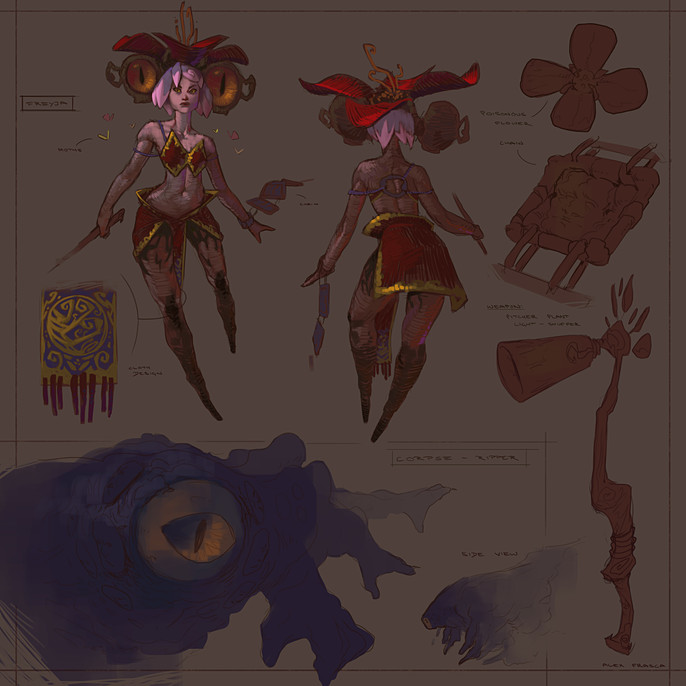
I began the final concept sheet once I had a very strong understanding of what I wanted Freyja to be. Here is the progress on that:
Illustration
Many of my illustrations begin with a sketch. For me, there is a big difference between sketching to create a drawing and sketching to create a painting. There are three things I keep in mind when doing a sketch that I intend to paint:
- Composition
- Story
- Dynamism
In my opinion, the most important of these is dynamism, though all three of these aspects are closely related. Anyway, by dynamism I mean the strength of the relationships between shapes, the movement of the character, and the use of confident lines and bold shapes. In my experience, the more you paint and render a sketch, the stiffer and less lively it gets. I try to compensate for this by creating an aggressively energetic initial sketch. Here was the first attempt:
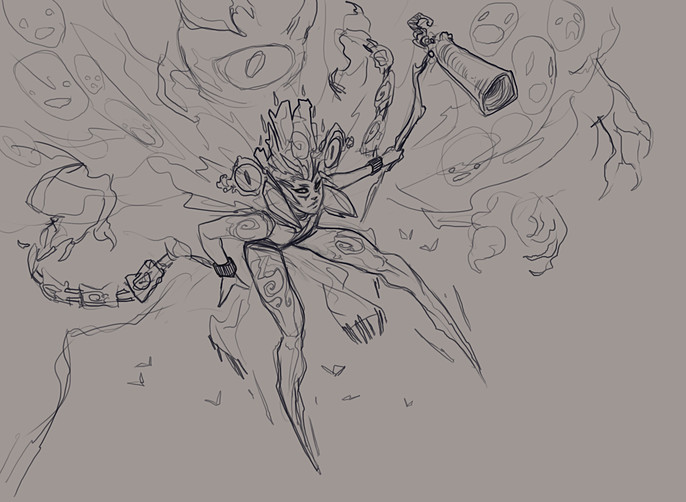
I liked this one, but I soon decided there was not enough movement, so I came up with this:
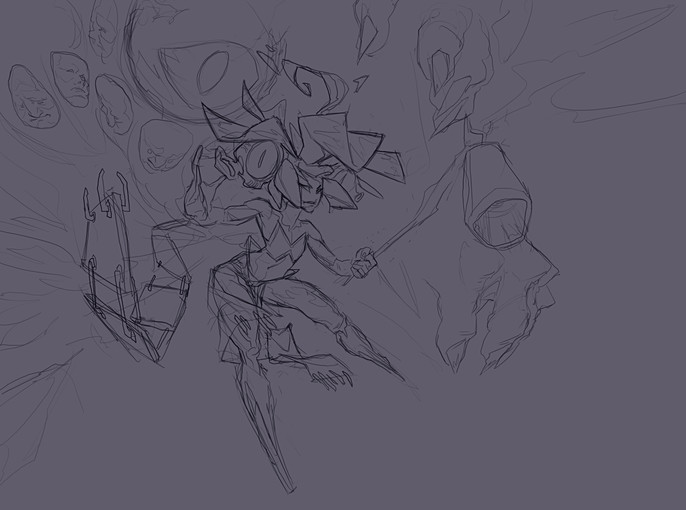
Bolder shapes, stronger perspective, more daring lines. I’m also taking more care with the secondary elements, such as Corpse-Ripper (the big cloudy demon guy) and the faces of tormented souls that are attached to his form.
My painting process involves darkening the canvas so it’s much easier to pick colors. I already had a solid idea of what her colors were going to be, so picking them wasn’t too much of a consideration. Notice that I like a lot of hue variation in all aspects of the painting. Specifically, consider the underside of the flower on her head, her hair, her skin, etc.
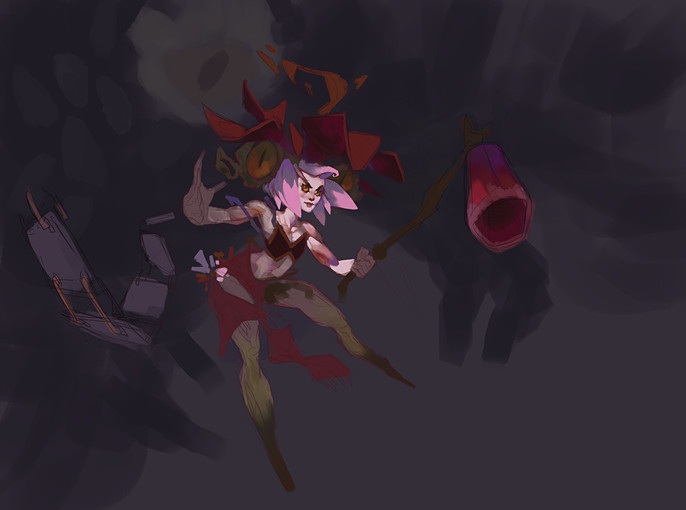
And a close-up:
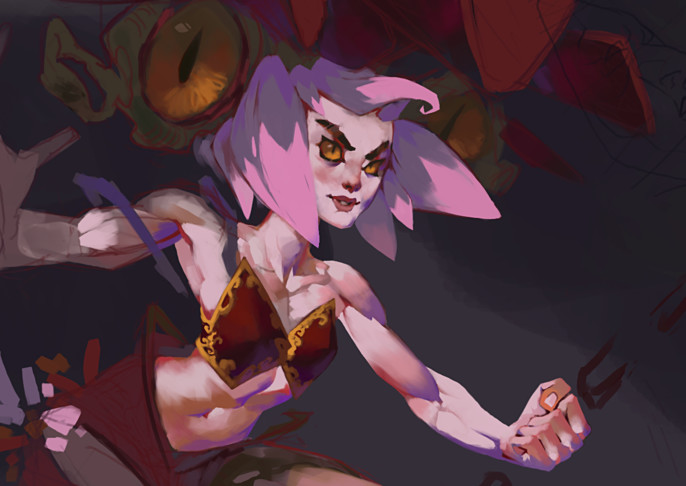
The face was hugely important for me, as it is the main focal point of the image. I wanted to create a pixie-like character with diminutive yet somewhat angular features, big eyes, and pale skin. Notice the colors—I have a warm light coming from behind, a strong purple light coming from our lower right (Freyja’s left side), and a bright white moonlight coming from the camera (the main light source). The saturation of the red and purple lights is unrealistically strong, but that’s intentional! Crazy colors are simply a part of my style.
Here is some progress:
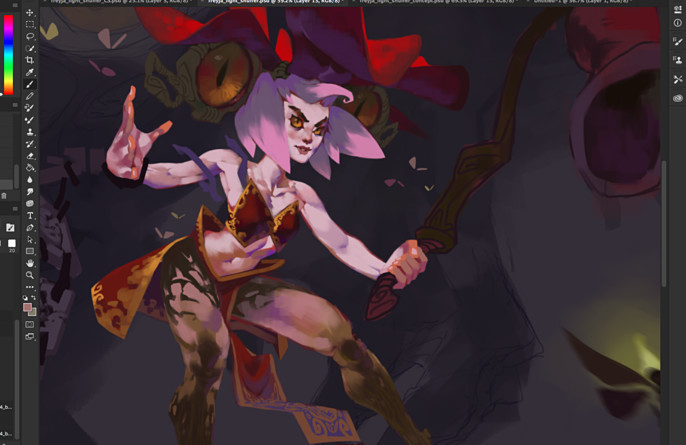
My painting process involves minimal rendering except in areas where I want the viewer to focus. For example, consider the moths: just two shapes of color to represent the wings. No body, no antennae, no detail. There is something about simplicity that appeals to me, so I implement it in my work. Generally I like to keep things one or two solid colors wherever possible. I also added some moths, which are an aspect to her design and also make for a strong compositional element. Notice she has her weapon, a pitcher-plant inspired candle-snuffer, which is about to ensnare a firefly. This was the inspiration for her backstory, which I will include here:
Freyja was once a forest pixie who roamed the woods and lived in quiet seclusion. But on the first day of winter one thousand years ago, her soul was ensnared by the evil and fearsome Corpse-Ripper, the god of death and torment. She was forced to do his bidding, as she was fettered by his chain of captured souls. Then, one day, she broke free, but the evil in her still remained and so now she terrorizes the forests of her own volition. Now Corpse-Ripper merely watches over her as she destroys all light in the world one firefly at a time.
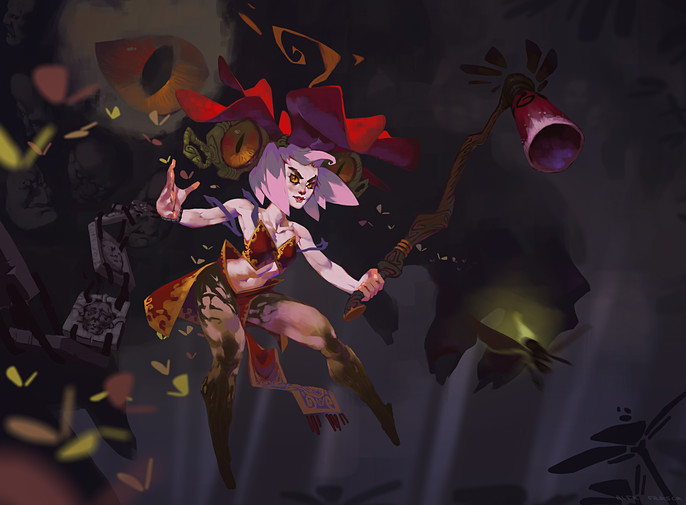
Now the final render:
Close-up:
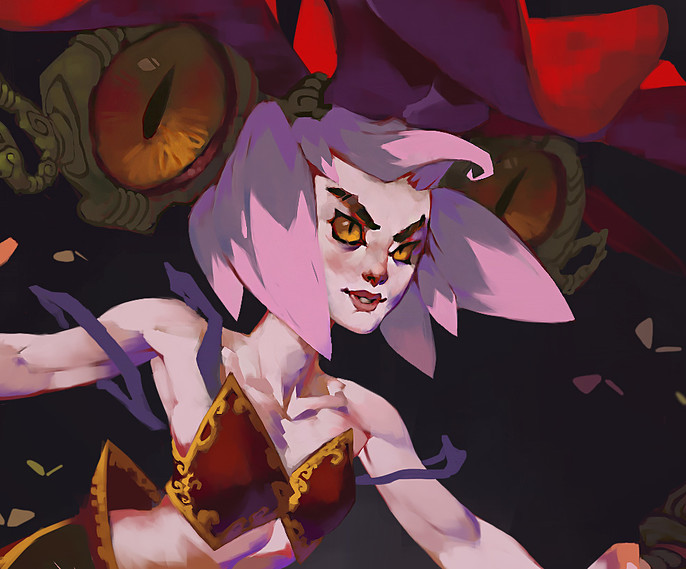
My overall painting process is fairly straightforward. Some things I always keep in mind:
- Keep it simple.
- Make every shape as appealing as you can (I try to avoid perfect circles, straight lines, right angles, parallel lines, etc.)
- Don’t just color-pick and blend your way through it. Keep the colors fresh and saturated by picking them from the color wheel!
- Don’t lose focus. The painting is about her, and the viewer should know that! In the focal point, use high contrast, sharp edges, bright and saturated colors, bold shapes.
A quick note: I created a sense of depth in this image by blurring moths that are closer and farther from the viewer, which simulates a camera’s (or an eye’s) focus. I blurred each moth individually by using separate layers and Adobe Photoshop’s blur settings: Filter > Blur Gallery > Field Blur. The closer the moth is to us, the blurrier it is.
I hope you enjoyed this making-of, and thank you for reading!
See the process on the Cubebrush forums here.